
Seasonality is one of the quieter voices in my confluence framework. It never tells me what will happen — it tells me what has tended to happen at this point in the calendar. And in the first days of September, that voice leans me toward my short signals on the S&P 500.
What Is Seasonality, in Short?
Seasonality is the tendency of a market to behave in a certain way at a certain time of the year. It is not magic and it is not a forecast. It is a statistical pattern that keeps repeating because the same causes come back every year: fund flows, quarterly rebalancing, tax dates, holidays, earnings cycles, harvest and energy cycles — and simple crowd memory.
The most common form is monthly: for every month of the year we can look back over decades and ask, "how did this month usually go?" You can also build seasonal patterns per week, per day of the month (turn-of-month is a well-known one), even around elections.
The key word is tendency. Seasonality shifts probabilities. That is all — but in trading, a small shift in probability, repeated often, is worth a lot.
September and the S&P 500
September has historically been the weakest month of the year for the S&P 500. Over the long run it is the month with the lowest — and often negative — average return, and it is also known for above-average volatility. There is no single cause; the usual suspects are the end of the summer lull, funds tidying up before the fourth quarter, and the fact that September follows the two weakest months of the seasonal cycle for many assets.
That is exactly why, when September comes around, I am quicker to take my short S&P 500 signals, and I demand more from a long. A seasonal headwind is not a veto — if my levels and indicators give a long signal in September, I take it, but I take it with less size and less patience. Seasonality does not decide the trade. It sets my bias.
The Long-Term Picture
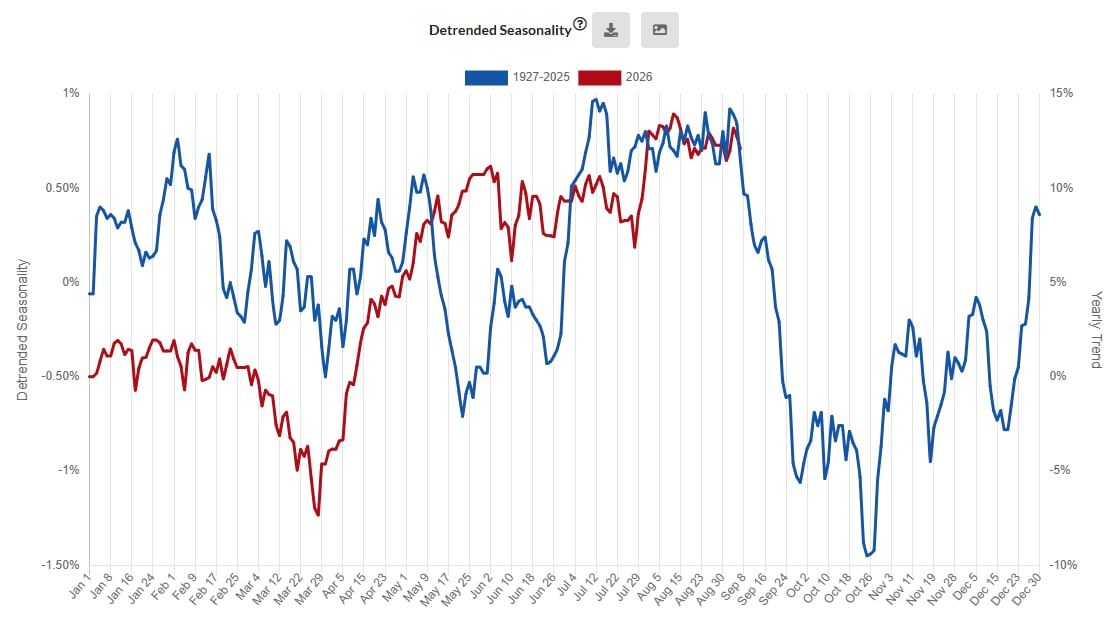
Read a chart like this as a map, not as a promise. It shows where the historical tailwind and headwind usually sit during the year — and it is the same map I glance at when I decide how much weight to give my signals this month.
Gold and Forex Are Just as Seasonal
Seasonality is not just an equity-index story. Two markets I follow closely are strongly seasonal too:
- Gold — the seasonal pattern is one of the clearest of all commodities. Prices tend to firm into the winter months (the run-up to Chinese New Year and the Indian wedding season are the classic physical-demand drivers) and to drift through the summer lull. These dates are not random: they follow the physical calendar of the buyers.
- Forex — currencies have their own rhythm from capital flows rather than from weather: quarter-end and year-end rebalancing, tax seasons, the summer liquidity drain, and the seasonal cycle of the commodity currencies (AUD, NZD, CAD follow their export seasons). Even the dollar tends to have a repeating rhythm across the year.
Different markets, same logic: something real happens on a schedule, and the price history shows it.
Seasonality Is One Vote, Never the Whole Story
The mistake is to trade seasonality on its own. "September is weak, so I sell" is not a strategy — it is a coin flip with a slight tilt and no risk management. In my confluence approach, seasonality is one vote next to the things that actually time a trade: price levels, structure, and indicators like WaveTrend and Supertrend.
A seasonal pattern tells you when to be more alert. It never tells you what to do. The signal does that.
When the calendar and the signals point the same way, I size up with more confidence. When they disagree, I trade smaller and take profits sooner. Same signal, different conviction — that is the entire value of seasonality.
The Bottom Line
Seasonality is the market's yearly calendar: recurring patterns driven by flows, demand and habit, repeating because the causes repeat. It is a bias, not a trigger — and right now, early September, it is one of the reasons I am more willing to be short the S&P 500 than long it. Gold and forex deserve the same seasonal attention.
Use it as one more vote in the confluence, never as the whole vote.
Trading futures and options involves substantial risk of loss. Past performance, including live results, is no guarantee of future results. This article is for educational purposes and is not financial advice.
🚀 Trade with rules, not feelings
Symtrade sends clear, systematic signals with defined entry, stop-loss, and take-profit levels — so you don't have to rely on your gut.
Subscribe Now